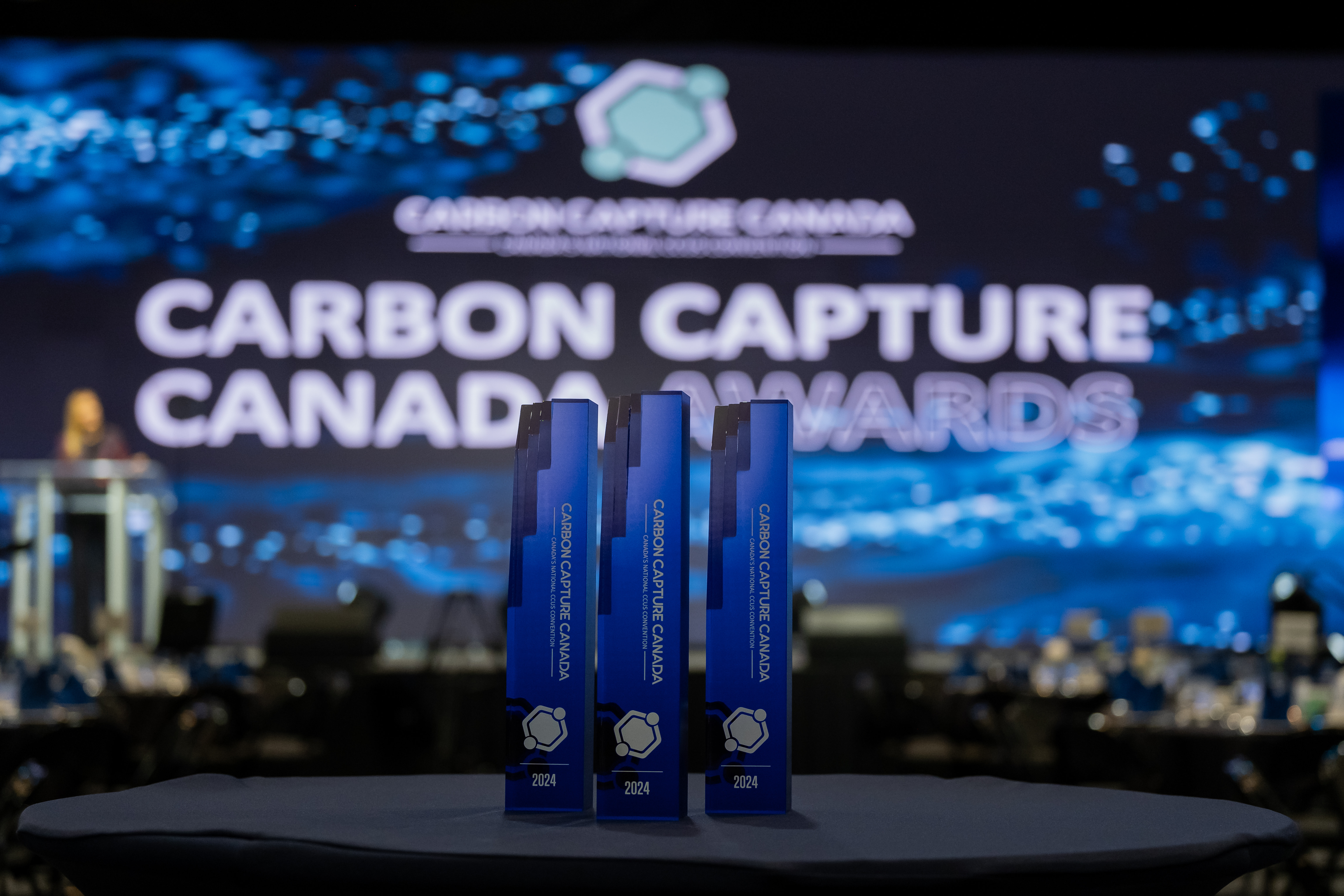
CARBON STORAGE & UTILIZATION AWARD

CMG

The "Predictive Monitoring for CCS" workflow is a sophisticated integration of two industry-leading technologies: CMG’s high-fidelity reservoir simulation and SpotLight’s agile focused seismic. By replacing sporadic, high-cost, full-field 3D seismic surveys with high-frequency, targeted "spot" measurements, this workflow enables operators to validate reservoir models in near real-time. This predictive approach continuously tests subsurface assumptions against actual seismic data, drastically reducing uncertainty regarding CO₂ plume migration and storage integrity.

Wood

Wood Group has developed an integrated surface–subsurface modeling workflow for CCUS systems that simulates the full CO₂ value chain, from capture and transport to injection and long-term storage. By dynamically coupling surface facilities, pipelines, wellbores, and reservoirs, the framework provides consistent representation of thermodynamic and flow behavior across the system. It combines multiphase flow simulation, transient wellbore modeling, and compositional reservoir simulation to capture pressure, temperature, and phase changes during steady-state and transient operations. This enables evaluation of key risks such as hydrate formation, multiphase flow, and injectivity changes, improving system design, operational reliability, and long-term storage performance.

CCUS INFRASTRUCTURE AWARD

Cetri

The Mobile Carbon Capture Unit (MCCU), developed by the Clean Energy Technologies Research Institute (CETRI) at the University of Regina, is a compact, skid-mounted carbon capture platform designed for industrial testing, demonstration, operator training, and technology validation. The fully integrated system combines flue gas pretreatment, carbon dioxide absorption and regeneration, process monitoring, gas analysis, and automated control systems within a transportable platform that can be deployed directly at industrial facilities to support carbon capture testing, technology validation, workforce training, and deployment decision-making.

Enhance

Enhance Energy’s Origins CCS Hub is an open-access carbon sequestration system designed to support large-scale decarbonization across Alberta’s industrial corridor, from Alberta’s Industrial Heartland to Central Alberta. This project is led by Enhance Energy, a founding partner of the Alberta Carbon Trunkline Project, and Origins builds on CCS infrastructure and Enhance’s operational expertise to create a scalable, reliable hub for permanent CO2 storage.

Strategically located in Central Alberta, Origins is designed to connect hard-to-abate industries and large emitters to permanent carbon sequestration. From commissioning, the Origins hub will be ready to store up to 1.5 million tonnes of CO2, already making it one of the largest CO2 storage projects in the world. With capacity to grow from there, this project represents foundational infrastructure in the province to support new large emitters for decades to come.  The Origins CCS Hub advances Canada’s low-carbon economy and demonstrating how integrated transport and storage systems can accelerate CCS deployment.

OBSIDIAN

Obsidian Engineering has developed a Risk-Based Operational Readiness Framework for CO₂ Transportation Infrastructure to support the safe, reliable, and scalable deployment of carbon capture, utilization, and storage (CCUS) projects. The framework combines thermodynamic analysis, transient operating assessments, and risk-based engineering principles to develop robust operating procedures for pipeline filling, depressurization, shut-in, restart, and system purging. By integrating operational considerations into the engineering design process, Obsidian Engineering helps clients reduce operational risk, improve infrastructure reliability, and enhance long-term pipeline integrity. This methodology supports the successful deployment of CO₂ transportation systems that are critical to enabling large-scale CCUS across North America.

DIGITAL INNOVATOR AWARD

Carbonquest

CarbonAI™ is CarbonQuest’s proprietary AI-powered control intelligence platform, embedded in every CarbonCapture™ deployment through the Carbon Capture Operating System (CCoS™). Operating across CarbonQuest’s complete cloud-to-edge platform, AI optimization models run in the cloud — processing operational data and generating control vectors delivered to the CarbonEdge™ industrial edge gateway for real-time site execution. In the event of connectivity interruption, CarbonEdge™ operates autonomously on the most recently delivered parameters, ensuring continuous, uninterrupted capture performance.

Using model-predictive control (MPC) and reinforcement machine learning (RML), CarbonAI™ predicts and adapts to continuously changing plant conditions — unlocking greater CO₂ recovery, higher output quality, and more predictable operations than fixed-cycle or manually tuned approaches, without expert operator presence on site

SIEMENS

The Siemens gPROMS Cement Decarbonization Digital Twin helps cement producers and technology providers model cement production and carbon capture in one integrated environment. Unlike conventional tools that assess them separately, it provides a plant-wide view to compare decarbonization options, improve energy use and emissions performance, and reduce technical and economic risk before implementation. It helps accelerate lower-carbon pathways for one of the world’s hardest-to-abate industries.

Vanmok

Vanmok CO₂ Pipeline Simulator is an advanced digital platform developed to improve the safety, reliability, and operational understanding of CO₂ transportation systems used in CCUS projects. The platform combines refined thermodynamic modeling and transient hydraulic simulation to accurately model dense-phase and supercritical CO₂ pipeline behavior during normal and emergency conditions. It enables evaluation of decompression, rupture, phase transition, and transient operating scenarios while supporting safer pipeline design, leak detection, FEED studies, operational optimization, and digital risk assessment for emerging CO₂ infrastructure.

INNOVATION IN CCUS TECHNOLOGY AWARD

Axens

Building on 60 years of experience and continuous innovation, Axens provides CO2 capture solutions as well as a comprehensive suite of flue gas pretreatment and CO2 conditioning processes.  Axens and IFPEN developed the DMXTM process specifically to address the primary challenge facing post-combustion CO2 capture projects:  OPEX related to solvent degradation and energy consumption. This breakthrough, amine-based CO2 post-combustion capture process utilizes a unique and innovative feature: the solvent undergoes a phase separation (or demixes) when mildly heated, creating CO2 lean and CO2  rich liquid phases via simple decantation. Only the CO2 rich phase needs to be regenerated, resulting in lower energy consumption and significantly lower degradation rates since the thermal degradation associated with solvent regeneration is minimized.

BASF

OASE® aerozone is a patented emission control technology developed by BASF as part of OASE® blue solvent based post combustion carbon capture (PCC) offering. It is specifically designed to mitigate aerosol related emissions which is one of the most persistent operational and permitting challenges in PCC installation.

Carbonquest

CarbonQuest’s CarbonCapture™ LP-VSA platform is a fully programmable, adsorbent-agnostic carbon capture architecture purpose-built for the distributed CCUS environment. Engineered with a very low pressure drop and vacuum-driven sorbent regeneration, it eliminates the high-pressure compression infrastructure required by conventional PSA systems — reducing CapEx, simplifying site integration, and lowering energy intensity per tonne captured.

Its fully programmable cycle architecture decouples hardware investment from the evolving sorbent materials landscape: new solid adsorbents can be adopted through software-based process reprogramming, no hardware replacement required. As next-generation materials with higher working capacities, faster kinetics and lower operating pressures emerge, platform performance improves within the same installed asset. Commercially deployed and demonstrating multi-adsorbent programmability at a Canadian field site.

Carbonstrike

Over the past three years, PETRONAS Energy Canada and PETRONAS Research have developed the Membrane Box Contactor (MBC), an innovative post-combustion carbon capture technology. Leveraging four field demonstration facilities in British Columbia, MBC combines patented high-mass-transfer membranes, a proprietary amine formulation, and a specialized construction approach. Key milestones include doubling membrane capacity within the same footprint, successfully operating a 20 TPD unit that validated 30–40% capital cost savings, and securing a commercial-scale project in Alberta capturing 166 TPD of CO₂. MBC achieves over 90% CO₂ recovery, requires significantly less material, and lowers capture costs by 30–40% compared with current technologies.

Ionada

Ionada developed a breakthrough modular carbon capture system based on Hollow Fiber Membrane Contactor (HFMC) technology, enabling efficient, scalable CO₂ capture in environments where conventional systems are too large or complex.

By replacing large absorber towers with compact membrane modules, Ionada delivers a containerized solution that is up to 50% smaller and up to 30% more energy efficient than traditional amine systems.

The technology has been validated through a 1 tonne per day pilot plant, achieving over 86% CO₂ capture efficiency over 1,400 hours of continuous operation, demonstrating reliability under real world conditions.

Designed for space-constrained emitters, Ionada’s system can be deployed across midstream compressions stations, FPSO platforms, and industrial facilities, helping operators meet increasingly stringent emissions regulations while maintaining operational performance.

Mantel

Mantel is the carbon capture company built for heavy industry and power generation, delivering energy-efficient and cost-effective carbon capture. Its high-temperature, liquid-phase carbon capture system uses proprietary molten borate technology to capture CO₂ directly from industrial operations while recovering process heat as usable steam.

Unlike other CCS solutions on the market today, Mantel’s liquid continuously absorbs and releases CO₂ in a repeating chemical cycle, creating a self-sustaining thermal loop that recovers energy rather than wasting it. The process is 50 times more efficient, reduces energy losses by 97%, and produces a CO₂ stream exceeding 99.9% purity, ready for sequestration or utilization without additional treatment. With minimal retrofits, Mantel integrates seamlessly into oil and gas facilities, power generation plants, chemical facilities and more. This makes carbon capture both technically feasible and economically viable at scale.

Nippon Steel

Our technology is a significant advancement in corrosion-resistant tubular materials for CCS environments, where CO₂-rich fluids coexist with water and impurities such as H₂S. Our proprietary portfolio, including SM25CRW and the newly developed 25CRU, addresses key challenges such as sulfide stress cracking and CO₂ corrosion. Developed through extensive laboratory testing and validation under realistic CCS conditions, these materials deliver reliable performance in aggressive environments. SM25CRW has demonstrated proven corrosion and cracking resistance in global deployments, while 25CRU offers similar protection with improved cost efficiency. The technology supports reliable, scalable CCUS infrastructure by enhancing durability while reducing deployment costs.

Sulzer

MellapakCC™ is an advanced mass transfer product solution specifically developed to optimize solvent based carbon capture systems. By fundamentally intensifying gas–liquid interaction and hydraulic behavior within the absorber, MellapakCC™ significantly reduces energy demand while maintaining high CO₂ capture efficiency.

The technology delivers up to 50–60% reduction in pressure drop, lowering the energy requirement of the flue gas blower and enabling more compact and cost-efficient plant designs. As part of Sulzer’s integrated carbon capture portfolio, MellapakCC™ supports reliable, scalable deployment of carbon capture systems across a wide range of industrial applications.

CCUS ENABLER AWARD

Carbon Management

Carbon Management Canada (CMC) is a leading specialist in advancing strategies and technologies for emissions storage, management and reduction that shape Canada’s low-carbon landscape. We support large-scale carbon management projects through innovation and applied research activities, with a focus on monitoring carbon in the subsurface, the validation and integration of fugitive emissions monitoring technologies, and the development of a skilled workforce through training, education and outreach.

Carbon Removal

Carbon Removal Canada is an independent non-profit accelerating the responsible scale-up of carbon removal technologies by advocating for impactful policy grounded in rigorous research, shaping market development, and connecting the right people to the right information.

They work closely with public and private actors to rapidly build the carbon removal industry. Together, these partnerships can position Canada as a global leader in climate technology, unlock investment for carbon removal, and drive economic growth.

Cetri

The Clean Energy Technologies Research Institute (CETRI) at the University of Regina advances carbon capture, utilization, and storage (CCUS) through applied research, technology development, industrial collaboration, workforce training, and international technology transfer. CETRI works with industry, governments, academic institutions, and international organizations to develop practical solutions that support industrial decarbonization and accelerate the deployment of clean energy technologies.

KOSAW

GBI ExoGen Power is an Indigenous-led clean technology joint venture focused on industrial decarbonization, environmental stewardship, and sustainable economic development. The organization develops and promotes innovative technologies and collaborative project models that support emissions reduction, resource efficiency, environmental remediation, and clean energy deployment. By combining Indigenous participation, technology innovation, and practical commercialization strategies, GBI ExoGen Power helps advance Canada’s climate and sustainability goals. Recognizing that net-zero requires multiple solutions, the organization supports initiatives spanning carbon capture, utilization and storage (CCUS), carbon avoidance technologies, industrial efficiency, resource recovery, and sustainable energy systems, helping build the foundation for future decarbonization projects across Canada.

CCS

The Carbon Capture, Utilization, and Storage Insight Accelerator (CCUSIA) is an initiative established in 2023 through a partnership between the Government of Alberta (GoA) and the International CCS Knowledge Centre (Knowledge Centre). The CCUSIA was created to accelerate and de‑risk CCUS deployment by providing transparent, credible, and publicly accessible insights across the full CCUS value chain.

Through a comprehensive suite of tools, resources, and interactive content, CCUSIA supports early‑stage decision‑making, improving the understanding of technology performance, project economics, policy considerations, and lessons learned from real projects around the world. By reducing technical and financial uncertainty, CCUSIA resources can enable operators, developers, and policymakers to make informed, confident choices that advance CCUS readiness and adoption across Canada.

Wood

Wood advanced global CCUS deployment by leading a pioneering Joint Industry Project focused on CO₂ specification guidelines. Bringing together energy companies, research institutions, and technology providers, the initiative addressed a key challenge in scaling CCUS: defining safe, efficient, and cost-effective CO₂ specifications across the value chain. The project produced the first freely available, science-based industry guidelines outlining the impacts of CO₂ impurities on capture, transport, and storage systems. Recognized through multiple international awards and nominations, the guidelines have helped reduce project uncertainty, support informed decision-making, and accelerate the safe, reliable, and economic deployment of CCUS projects worldwide.

EMERGING CCUS LEADER AWARD

Alex Petrie

Alex Petre serves as the Chief Executive Officer at Deep Sky, a Montreal-based climate tech pioneer and the world’s first technology-agnostic carbon removal project developer. Alex oversees the end-to-end development, deployment, and commercialization of multi-technology infrastructure designed to pull gigatonnes of CO2 from the atmosphere and store it permanently underground. With an extensive background in operations, infrastructure scaling, and financial advisory, Alex leads Deep Sky’s cross-functional teams across engineering, policy, and financing to accelerate global climate impact and establish Canada as a premier hub for the climate economy.

Guillaume Devaux

Guillaume Devaux is VP of Strategic Partnerships at Deep Sky, the world's first technology-agnostic carbon removal project developer. He leads global commercial development, signing offtake agreements with Fortune 500 companies, building channel partnerships, and forging international relationships to unlock revenue that finances and scales Direct Air Capture infrastructure. Since joining in January 2025 with no prior CCUS experience, he has built a pipeline in the hundreds of millions of dollars, signed approximately 10 multi-year offtakes, and opened new DAC opportunities in Japan and China.

Nicole Harbauer

Nicole Harbauer is a Trade Commissioner with Global Affairs Canada, where she supports Alberta-based energy sector and cleantech companies looking to seize international opportunities. Nicole develops programming to showcase Canadian capabilities in carbon management to international buyers and investors. She is a member of the Board of Directors of the Petroleum Technology Alliance Canada (PTAC), and the Steering Committee for the Clean Resource Innovation Network (CRIN). Previously based in the United Arab Emirates, Nicole led the development of Canada’s commercial program at Expo 2020 Dubai and served as a member of the Executive Committee of the Canadian Business Council in Dubai and the Northern Emirates.

Austin Eleba

Austin Enyiche Eleba is the Founder and Director of Global Integrated Concepts, an education and community development organization in Omoku, Rivers State, Nigeria — in the heart of the Niger Delta. He also serves as a Geography Teacher with the Rivers State Senior Secondary Schools Board and Director of Royal City Academy. Austin works at the intersection of environmental education, sustainability advocacy, and community development, with a focused commitment to advancing carbon capture and utilization as a scalable response to the Niger Delta's chronic gas flaring crisis.

Patit Pradoo

Patit is a Technical Specialist at the International CCS Knowledge Centre, where he contributes to the advancement of carbon capture and storage (CCS) projects across Canada. His work spans projects for clients in the pre-feasibility, feasibility, and Front-End Engineering and Design (FEED) stages of their potential carbon capture facilities, contributing expertise in process simulations, data analysis, and techno-economic evaluations. He plays a key role in informing practical, data-driven decisions for many different industries.

Prince Henry

Prince Henry Sampson Eduam is a Ph.D. candidate in Chemical and Biomolecular Engineering at The Ohio State University, specializing in CO₂ geosequestration in tight and organic-rich formations. His research integrates core-scale flow experimentation, pulse-decay permeability, Raman spectroscopy, X-ray photoelectron spectroscopy (XPS), and pore-scale characterization to investigate how CO₂ alters both transport behavior and the structural state of subsurface materials. His work advances a new interpretation of CO₂ storage as a state-dependent process, where adsorption-driven structural evolution governs long-term retention beyond conventional multiphase flow descriptions. By linking nanoscale transformations to macroscale transport response, his research is establishing new frameworks for evaluating storage performance, containment security, and enabling data-driven and AI-assisted approaches in CCUS.

Irene Lock

Ir. Ts. Irene Lock Sow Mei is a Senior Process Engineer at PETRONAS Group Technical Solutions whose work supports industrial decarbonization through the integration of water, process, and sustainability engineering. Specializing in water stewardship, resource efficiency, and digital optimization, she develops solutions that improve environmental performance and operational reliability across energy facilities. Her expertise in the water–energy–carbon nexus positions her at the forefront of emerging low-carbon technologies, including green hydrogen, circular carbon systems, and the foundational infrastructure that enables future CCUS deployment.

CARBON CAPTURE PROJECT AWARD

Cetri

The Mobile Carbon Capture Unit (MCCU) Demonstration Project is an international industrial decarbonization initiative led by the Clean Energy Technologies Research Institute (CETRI) at the University of Regina. Developed to support carbon capture deployment in Thailand’s cement sector, the MCCU is a compact, skid-mounted, transportable carbon capture system designed to demonstrate post-combustion CO₂ capture under real industrial operating conditions. The unit was designed, fabricated, tested, and shipped from Canada to Thailand in March 2026. Commissioning and operator training are scheduled for late June and early July 2026, with field operation expected to begin shortly thereafter. The project demonstrates the practical application of Canadian-developed carbon capture technologies to support industrial decarbonization in Thailand's cement sector while facilitating international technology transfer and capacity building.

Enhance

The Origins CCS Hub is a globally significant carbon sequestration project that will large-scale, permanent emissions reduction and support the decarbonization of hard to abate industries. Origins is developed by Enhance Energy, a CCUS leader, as the operator of the Clive CO2 Sequestration Facility, the developer of the Origins CCS Hub, and one of the founding partners of the Alberta Carbon Trunkline (ACTL) Project. Origins builds on Enhance’s proven success to create one of the most impactful carbon sequestration projects in development today.

Entropy

The Glacier CCS Project is a first-of-kind commercial deployment of post-combustion carbon capture at scale, capturing emissions from 11 natural gas compressor engines and a 15 MW gas-fired turbine at Advantage Energy’s Glacier Gas Plant in Alberta. Building on four years of successful operation in Phase 1, the Phase 2 expansion (2025–2026) integrates carbon capture with permanent geological storage to produce low-carbon natural gas and clean firm electricity. The facility processes up to 425 MMcf/d of natural gas, enough to heat approximately 1.5 million Canadian homes, while delivering power with life-cycle emissions below 100 kg CO₂e/MWh. Glacier demonstrates the commercial viability of large-scale carbon capture for low-carbon energy production.

CCUS LEADER OF THE YEAR AWARD

Ericka Rios

Ericka Rios is a Professional Engineer and senior clean technology leader at Alberta Innovates, Canada’s provincial clean tech agency, where she directs a multi-million-dollar investment portfolio spanning carbon capture and storage, carbon dioxide removal, hydrogen, and nature-based solutions. She leads Alberta’s international partnerships strategy to advance CDR innovation, evaluates emerging CCUS technologies for investment readiness, and designs impact measurement frameworks that translate technical outcomes into government and executive accountability. A Governing Body Member of Carbon Capture Canada and 2025/26 Energy Futures Lab Fellow, Ericka is one of the most influential engineers shaping Alberta’s—and Canada’s—carbon management strategy.

Ahmed Osman

Dr Ahmed I. Osman works at the interface of carbon capture, utilization and storage, carbon dioxide removal, biochar systems, methane conversion, hydrogen, e-methanol, life-cycle assessment and techno-economic analysis. His role is focused on making carbon-management technologies credible for real decisions, not only academically interesting. Across more than 19 years in academia and applied research, he has built an international research profile in sustainable energy and circular engineering, with 219 Scopus-indexed publications, an h-index of 88, more than 32,000 citations and 14 Highly Cited Papers. His work helps connect laboratory science, policy evidence, industrial feasibility and public understanding of CCUS-relevant pathways.

Omid Nik

Omid Ghaffari Nik is Vice President, Materials Science and Process at CarbonCapture Inc., where he leads the development, scale-up, and integration of advanced sorbent materials for direct air capture. He is a chemical engineer with more than 15 years of experience in CO₂ capture materials, including MOFs, amine-based solid sorbents, porous adsorbents, material characterization, industrial scale-up, and deployment-focused testing.

Omid’s work is centered on a practical but difficult goal: turning promising carbon capture materials into technologies that can be manufactured, shaped, tested, installed, and operated in real systems. His leadership includes industrial-scale development of CALF-20 for point-source CO₂ capture and structured sorbent development for Project Tamarack, CarbonCapture’s direct air capture system deployed at Deep Sky Alpha in Alberta.

Shane Johnson

Shane Johnson is an accomplished serial entrepreneur with more than 30 years of technology innovation and commercial leadership across the energy and telecommunications sectors. As co-founder and President & CEO of CarbonQuest, Inc., Shane has brought to market a proprietary distributed carbon capture technology platform that makes CCUS accessible and economically viable at the point of emission — from commercial buildings and industrial facilities to renewable natural gas operations and data centers. Over his career, Shane developed five distinct “first-of-its-kind” ventures, all of which are still operating today. Two of the ventures lead to successful acquisitions by publicly traded international companies. At CarbonQuest, he has assembled a world-class technical and commercial team, raised $36 million in funding including a landmark $20M Series A from Riverbend Energy Group, and driven commercial deployment across multiple sectors — while helping establish the Spokane, Washington region as a recognized hub for clean energy innovation.

Phil De Luna

Phil De Luna is the Co-Founder and CTO of CURA, a Canadian climate-tech company developing electrochemical technology to decarbonize cement and lime production. CURA’s proprietary low-voltage electrolyzer technology aims to eliminate process emissions from cement manufacturing, an industry responsible for approximately 8% of global CO₂ emissions. Previously, Phil served as Chief Science and Commercial Officer at Deep Sky, where he helped raise more than $100 million to scale direct air capture technologies, led development of the Deep Sky Alpha DAC plant, and secured multi-million-dollar carbon credit offtakes. Prior to Deep Sky, he led carbontech initiatives within McKinsey & Company’s Sustainability Practice and was the youngest-ever Director at the National Research Council of Canada, where he built and led a $57 million R&D program advancing Canadian net-zero technologies.

Greg Maidment

Greg Maidment is a Canadian carbon storage leader advancing first-of-a-kind CO₂ storage solutions for direct air capture (DAC) and industrial decarbonization. He led the drilling and injection of Canada’s first CO₂ mineralization well in Quebec and the first storage of DAC-derived CO₂ in Alberta, achieving a world-first injection into a sedimentary reservoir. His expertise spans mineralization, saline aquifer storage, geological screening, regulatory development, and commercial strategy. Greg has helped shape CCS frameworks in Quebec, Ontario, and Manitoba, while supporting carbon storage development in emerging regions across Canada. Through technical leadership, stakeholder engagement, and community outreach, he is helping establish the regulatory, technical, and social foundations required to scale permanent carbon storage nationwide.

Vinay Prabhayya Mulgundmath

Dr. Vinay Mulgundmath is a transformative CCUS leader at the forefront of developing, deploying, and commercializing carbon management technologies at Saudi Aramco. With 20+ years of experience across Canada, the UK, and the Middle East, he consistently bridges the gap between early-stage research and large-scale industrial implementation. As an Engineering Specialist, he brings deep technical execution and systems-level engineering expertise to the Jubail CCS Hub, a landmark project targeting 9 million metric tons of CO₂ capture annually, oversees a 12TPY Direct Air Capture demonstration, a 10TPD next-generation CO2 capture pilot and evaluating CCUS technologies for USD 7 Billion Aramco Ventures' sustainability fund.

Govind Hegde

Govind Hegde is a recognized leader in the Carbon Capture, Utilization and Storage (CCUS) space, serving as Energy Transition Team Lead for the Americas at Wood. With over 13 years of experience spanning advanced research and global consulting, he provides technical and strategic leadership for large-scale CCUS developments across North America. Govind has been at the forefront of innovation in integrated surface–subsurface modeling for CCS systems, helping redefine how CO₂ transport and storage systems are designed and operated. His work has directly supported major CCS developments, including projects with leading operators such as Exxon and large-scale CCS hub initiatives, where he has led flow assurance and system design efforts for multi-million tonne CO₂ transport and storage systems. Through his leadership, Govind has helped bridge the gap between surface and subsurface disciplines, enabling safer, more efficient, and scalable carbon storage solutions that are critical to achieving global decarbonization goals.

Warning!
Beware of email scams

DMG Events has been informed that several exhibitors are receiving scam emails. Please be aware these offers are fraudulent. These scammers do not have any relationship with DMG Events. In accordance with GDPR, CASL and other jurisdictional data privacy regulations, DMG Events will never sell your data to any third-party organizations. Please see our Privacy Policy for more information regarding how DMG Events will process and store your information.